[Yukta Chordia is a final-year student at National Law University, Nagpur. In this piece, the author interrogates the quasi-judicial role assumed by digital platforms through automated enforcement. While YouTube’s “Three-Strike” policy is framed as a shield for intellectual property, the author argues it has evolved into a mechanism for private censorship that bypasses statutory safeguards.]
YouTube’s automated copyright enforcement mechanism, which allows for the removal of content upon receipt of a copyright complaint, was originally designed to protect intellectual property rights. However, in practice, this mechanism often imposes disproportionate burdens on content creators, especially those engaged in commentary, criticism, and other transformative uses. This burden arises because YouTube removes content and issues strikes based on private complaints without judicial determination, effectively shifting the burden of proof onto creators. The result is disproportionate, as even weak complaints can trigger escalating penalties, culminating in channel termination and loss of livelihood. The mechanism, therefore, has been widely criticised for its failure to account for statutory fair dealing safeguards under Indian copyright law (see here, here and here).
This blog takes that critique a step further. It argues that the shortcomings of YouTube’s copyright enforcement framework extend beyond its disregard for fair dealing. In particular, it contends that the platform’s three-strike policy is also inconsistent with the domestic copyright regime and with safe harbour principles that are meant to prevent platforms from becoming private censors.
This blog proceeds by first outlining YouTube’s three-strike copyright policy. It then undertakes a comparative analysis of the Indian and the United States copyright frameworks, demonstrating how YouTube’s policy deviates from India’s more speech-protective notice-takedown-putback mechanism. It subsequently analyses the free speech costs of allowing platforms to act as private adjudicators. Finally, it suggests a procedural response to overbroad copyright strikes from the perspective of creators.
YouTube’s Three-Strike Copyright Policy
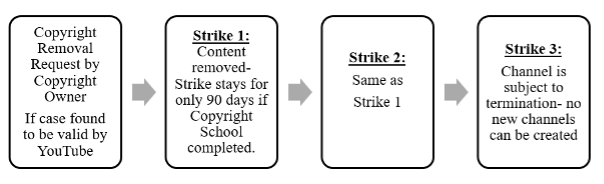
YouTube’s copyright enforcement system is structured around an automated “three-strike policy,” which allows the platform to remove content following a copyright removal request from a rights holder. Once such a request is reviewed and found to be valid, YouTube deletes the flagged video and issues a copyright strike to the uploader. A single strike results in the removal of the specific video, and the creator must complete Copyright School to have the strike expire after 90 days. If the creator fails to do so, the strike remains active. A second strike triggers the same process and warning. However, the accumulation of three active copyright strikes within a 90-day window results in permanent termination of the channel, along with the removal of all uploaded content and a ban on creating new channels.
The livelihood of millions of creators hinges on the operation of this policy. A creator who receives multiple complaints in quick succession faces the risk of losing not only specific content but their entire channel.
Comparative Analysis: The Indian and U.S. Copyright Laws
In India, the regulation of content takedown mechanisms operates under three interlinked legal instruments: the Copyright Act, 1957, the Copyright Rules, 2013, and the Information Technology Act, 2000 (“IT Act”). Whereas, the United States (U.S.) has enacted the Digital Millennium Copyright Act, 1998 (“DMCA”). This part of the blog draws an analysis of whether YouTube’s copyright enforcement in India adheres to the domestic legal framework or instead follows the U.S.-centric DMCA model.
YouTube qualifies as an “intermediary” engaged in the transient and incidental storage of user-generated content under Section 2(1)(w) of the IT Act, 2000. Section 52(1)(c) of the Copyright Act, 1957 read with Rule 75 of the Copyright Rules, 2013, explicitly recognises such activity as non-infringing, provided the intermediary acts in good faith and removes access to the content only upon receiving a written complaint. Importantly, the provision requires YouTube to restrict access temporarily for twenty-one days, pending a court’s determination of infringement. If no such order is produced within that period, the intermediary is permitted to restore access. The legislative intent behind this provision is clear, it aims to prevent intermediaries from assuming the role of adjudicators in complex copyright disputes and to ensure that allegations of infringement are resolved through judicial determination.
Conversely, the DMCA requires platforms to remove content “expeditiously” upon receiving a notice from the rights holder, with counter-notice opportunity for the accused party to contest the claim. This immediate removal mechanism, though efficient, often results in over-compliance, particularly when platforms operate on a global scale. The effect is that creators in India are subject to a privately administered takedown system that circumvents domestic procedural safeguards.
A side-by-side comparison helps illustrate how far YouTube’s global copyright policy departs from the legal position under Indian law.
| Copyright Act and Rules
(India) |
Digital Millennium Copyright Act
(USA) |
| Section 52(1)(c) of the Copyright Act r/w Rule 75 of the Copyright Rules permits intermediaries to temporarily disable access to allegedly infringing content upon receipt of a written complaint. | The DMCA, 17 U.S.C. §512, grants safe harbour to intermediaries who expeditiously remove content upon receiving a valid takedown notice from a rights holder. |
| Access to the content may be restricted for 21 days, pending production of a court order by the rightsholder, determining infringement. If no court order is produced within the prescribed period, the intermediary may restore access to the content. | Content is removed immediately upon notice, subject to a counter-notice procedure initiated by the user. If the rights holder does not initiate legal action after a counter-notice, the content may be reinstated. |
This comparison highlights a crucial structural difference between the two regimes. Under the DMCA, the sequence is notice → takedown → counter-notice → put-back, with the burden placed on the user to initiate the counter-notice process. By contrast, Rule 75 adopts a notice → takedown → put-back model after twenty-one days unless the rightsholder approaches a court, thereby shifting the burden onto the rightsholder to justify the continued restriction. This comparative framing usefully demonstrates how Indian law, at least at the level of delegated legislation, adopts a more speech-protective posture than its American counterpart.
Further, under Section 79 of the IT Act, intermediaries are entitled to “safe harbour” protection, provided they act upon court or government orders to remove unlawful content. The Supreme Court in Shreya Singhal v. Union of India AIR 2015 SC 1523 clarified that intermediaries cannot remove content merely on receiving private complaints. They must receive a court order or government notification to remove content.
However, the Delhi High Court’s decision in MySpace Inc. v. Super Cassettes Industries Ltd. 2016 SCC OnLine Del 6382 complicates any straightforward reliance on Shreya Singhal. While acknowledging that Shreya Singhal read “actual knowledge” under Section 79(3) to mean knowledge arising only from a court order or government notification, the Court held that this reasoning was articulated in the context of restrictions traceable to Article 19(2). In the specific context of copyright, it concluded that an intermediary may acquire “specific knowledge” of infringement through a rights holder’s notice identifying precise URLs, without the necessity of a prior court order.
Although the Court described this as a harmonious reading of the IT Act with the Copyright Act, it did not meaningfully reconcile this approach with Rule 75 of the Copyright Rules, 2013. At most, MySpace can be read as relaxing the trigger for an initial takedown by permitting action on specific private notice. It does not expressly displace the Rule 75 framework, which allows restoration after twenty-one days unless the rightsholder produces a court order. While the logic of MySpace undoubtedly weakens the practical force of this safeguard, it does not overrule it. Even accounting for this judicial relaxation, YouTube’s three-strike regime goes significantly beyond what either the statute or the case law permits.
Moreover, YouTube operates within a dual legal regime: it enforces its copyright rules through its private terms of service as a matter of contract, while simultaneously invoking statutory safe harbour protections under Indian law. This duality raises a more fundamental question about the relationship between contract and statute in platform governance. Can users, by assenting to YouTube’s terms of service, be taken to have contractually waived statutory safeguards, particularly those reflected in Rule 75, that are meant to constrain intermediary censorship?
The Free Speech Cost of Platforms Becoming Judges
While YouTube’s global policy largely mirrors the DMCA model, its direct transplantation into the Indian context raises significant legal inconsistencies. Copyright law is territorial in nature, and the DMCA’s procedures cannot be directly extended to Indian users. YouTube’s three-strike policy effectively overrides the domestic framework. Instead of merely disabling access for the prescribed period, the platform issues punitive measures that can culminate in the deletion of entire channels. This not only exceeds the scope of Section 52 but also undermines the intermediary’s neutral position by acting as both enforcer and adjudicator. The absence of judicial oversight, combined with the risk of permanent channel termination, transforms what should be a protective mechanism into a coercive one.
YouTube has evolved into a principal medium of public communication and commentary, functionally equivalent to a modern public square. The removal of entire channels based on unverified copyright strikes constitutes a disproportionate restriction on both speech and livelihood, particularly when such removals are not subject to judicial scrutiny of whether the underlying use is in fact fair. These forms of blanket enforcement exemplify the asymmetric power relations that structure the digital ecosystem, where large rights-holders and platforms exercise overwhelming control over individual creators.
At a constitutional level, this raises a deeper and unresolved problem. In Kaushal Kishore v. State of Uttar Pradesh (2023), the Supreme Court recognised, in principle, that certain fundamental rights, including free speech, may be invoked even against private entities performing public functions. Although platforms are private companies, they have a “parapublicistic” role, especially when large-scale enforcement is concerned (as discussed here). By this reasoning, creators should be able to invoke fundamental rights against platforms like YouTube, which play a central role in facilitating public discourse.
However, subsequent High Court decisions have sharply constrained the operational reach of this idea in the context of social media platforms. In Sanchit Gupta v Union of India (2024), the Delhi High Court dismissed a writ petition against X Corp, holding that the provision of a platform for communication does not constitute a “public function” so as to attract writ jurisdiction under Article 226. The result is a doctrinal disjunction. While Kaushal Kishore gestures towards the horizontal application of fundamental rights, recent High Court jurisprudence has left creators with little practical recourse against platform enforcement decisions. Creators thus find themselves in a state of constitutional limbo: subject to platform governance systems that profoundly shape their speech and livelihoods, yet largely unable to invoke constitutional constraints against those systems.
Remedies and Realignment with Indian Law
To align its operations with Indian law, YouTube should modify its copyright enforcement mechanism to reflect the safe harbour framework under Section 52(1)(c) and the procedural safeguards built in Rule 75. From the perspective of creators (as suggested here) Section 60 of the Copyright Act offers a concrete procedural response to overbroad copyright strikes. Where a rights-holder issues a takedown notice or initiates a strike in respect of content that is plausibly protected by fair dealing or is otherwise non-infringing, such a notice may be characterised as a “groundless threat” of infringement proceedings. In such cases, a creator may institute a suit seeking a declaration that the alleged infringement to which the threats relate does not, in fact, infringe any legal right of the person making those threats, and may further seek an injunction restraining the continuance of such threats. Courts may, in appropriate cases, grant interim injunctions preventing YouTube from deleting channels until liability is judicially determined.
Conclusion
What is ultimately at stake in YouTube’s copyright enforcement regime is not just the loss of videos or channels, but the normalisation of speech being taken down first and justified later. For many creators, a single strike is not just a minor inconvenience, it can mean lost income, lost visibility, and lasting damage to professional credibility. The deeper problem is that YouTube’s DMCA-driven system leaves no room for Indian copyright law to operate as intended. The platform ends up deciding questions of legality that the law reserves for courts. If platforms that now serve as central spaces for public conversation are allowed to exercise this kind of power without oversight, statutory safeguards and safe harbour protections begin to ring hollow. Until that power is checked, copyright enforcement on platforms like YouTube will remain less about protecting rights and more about controlling speech.

